The Room-Temperature Rule: Indonesian Green Sides That Hold Up on a Crowded Holiday Table
Photo: Bembety, CC BY-SA 4.0, via Wikimedia Commons
Every November, someone in the group chat volunteers to host Friendsgiving and then immediately regrets it. The bird takes the oven hostage. The kitchen counter disappears under foil-covered dishes. And somewhere around 6:45 p.m., a bowl of green beans goes gray in the corner while everyone hunts for the corkscrew.
Green sides get the worst of it. They're the first thing to wilt, the first thing to break a dressing, and the first thing the picky cousin skips. But they don't have to be. Indonesian cooking has spent generations building vegetable dishes that taste good warm, fine at room temperature, and perfectly respectable the next day — which is exactly the skill set a buffet demands.
Why Greens Fail on a Holiday Table (and Not in the Kitchen)
Most American green side dishes are engineered for the moment they leave the stove: crisp, glossy, chilled, or sauced at the last second. The buffet asks for something else entirely — a dish that's already good when it lands on the table and doesn't fall apart at minute forty-five.
Indonesian home cooks solved this by leaning on two ideas: cooked greens that are meant to be served at room temperature, and flavor that's built into the leaf rather than drizzled over it. A sambal on the side stays bright for hours. A vinaigrette on the greens does not.
Three Greens That Never Need the Oven
Oven space on Thanksgiving or Friendsgiving is a currency. So build your greens around the stovetop, the kettle, and the fridge.
1. Kangkung, blanched early, dressed late
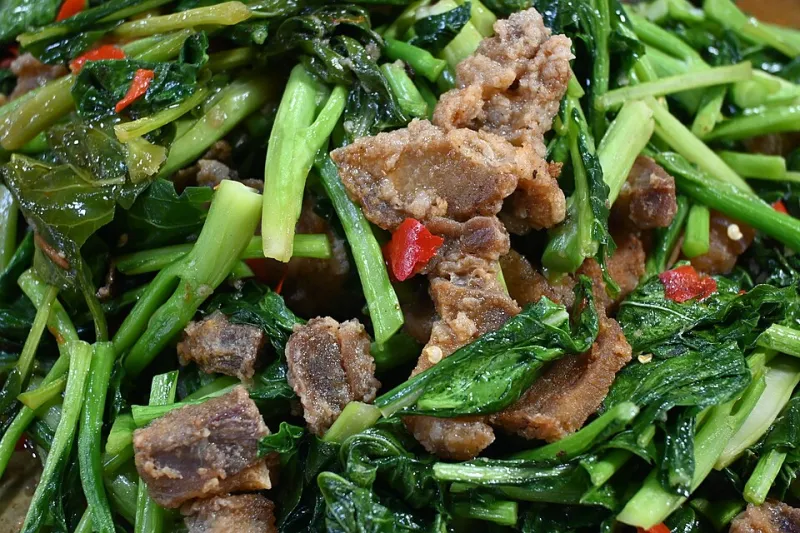
Water spinach — kangkung — has hollow stems that collapse into mush if you cook them twice. So don't. Blanch the whole bundle in salted boiling water for about 60 to 90 seconds, shock it in ice water, then squeeze it dry in a clean towel and refrigerate it in a container with a paper towel. At serving time, toss it with garlic, chili, a little lime, and a splash of kecap manis. Total last-minute effort: ninety seconds. If you can find it at an Asian market, use it; otherwise regular spinach or tender chard works, though it'll need less time in the water.
2. Daun salam braised greens
This is the one that surprises people. Simmer sturdy greens — collards, mustard greens, or a bag of chopped kale — with a couple of daun salam leaves, garlic, shallot, and a little coconut milk until they're silky. Daun salam brings a quiet, savory-herbal note that reads as "something's in here" without reading as unfamiliar. It gets better after a night in the fridge, which puts it in direct competition with every other dish on the table.
3. Urap-style coconut greens
Blanched green beans, cabbage, or spinach tossed with toasted unsweetened shredded coconut, grated garlic, chili, lime, and salt. Keep the coconut mixture in a separate container and fold it in when you arrive. Nothing about it needs heat.
The Picky-Crowd Play
Here's the quiet advantage of the Indonesian approach: you can serve the components separately and let people assemble their own plate. Plain blanched greens on one side, sambal in a small bowl on the other. Greens that aren't spicy, with the chili option labeled. This is not a compromise — it's how a lot of Indonesian tables actually work anyway.
Label the heat level on anything with chili. Aunt Linda will thank you, and so will the seven-year-old who treats green food like a personal insult.
What Travels Well: A Short Checklist
- Keep the acid and salt for the destination. Dressed greens weep. Dress them in the host's kitchen.
- Dry the leaves before you pack them. A salad spinner and a towel do more for texture than any technique later.
- Pack crunchy toppings separately. Fried shallots, toasted coconut, crushed peanuts — all separate, all added at the end.
- Skip anything that's mostly water. Cucumber-heavy salads and brothy dishes leak through the car seat and the buffet line.
- Use containers you don't need back. You will not get your good Tupperware home.
- Write the reheat or no-reheat instruction on masking tape. Nobody remembers what you told them at the door.
Reheating Without Turning Them to Slime
Most of these dishes don't need reheating at all, and that's the point. But if you want them warm:
- Microwave in 20- to 30-second bursts, stirring between each. Ninety seconds is plenty. Three minutes is a crime.
- Use a skillet over medium heat for braised greens — a splash of water, a lid, three minutes.
- Never re-boil blanched kangkung. You've already cooked it once.
- Mind the two-hour rule. Anything that has sat out longer than two hours goes in the trash, not back in the fridge. This matters more than any flavor concern.
A Timeline That Fits Someone Else's Turkey
Tuesday: buy the greens, wash and dry them, toast the coconut, fry the shallots.
Wednesday night: blanch and shock the kangkung; braise the daun salam greens; both go into the fridge.
Thursday morning: pack everything cold, with the sambal in its own jar and a towel in each container.
Thursday, 30 minutes before eating: dress the greens in the host's kitchen, fold the coconut into the urap, and find a spot on the table before the sweet potatoes claim it.
That's the whole strategy. Not a showstopper — just a bowl of greens that's still worth eating when the plates come back around for round two.